

If fear has kept you away from the dentist, you are in a very large group, and nothing about it needs to be fixed before you come in. Dental anxiety ranges from mild dread the night before to a fear strong enough that people live with pain rather than make the call. All of it is workable. The first step is not treatment; it is a conversation about what makes treatment hard for you and how we will handle it.
Comfort during dental care comes from a handful of ordinary things done carefully: knowing what is going to happen before it happens, being certain you can stop it, not feeling pain, and moving at a pace you can manage. None of these require anything exotic. They require you to tell us, and us to listen.
This page explains how to identify what actually worries you, what you can ask for at any visit, how to prepare, and how a first appointment can be shaped so that nothing happens until you are ready for it.
Identify the part that worries you
"I hate the dentist" usually turns out to mean something more specific, and the specific thing is what we can plan around. Common sources of fear include:
- Pain, or the memory of pain from a visit years ago, often from a time when numbing was less reliable.
- Needles. For some people the injection is the whole problem and everything after it is fine.
- Sounds and sensations: the drill, the suction, the scraping of a cleaning, the vibration in the jaw.
- Gagging, especially with X-rays and impressions.
- Loss of control: lying back, not being able to speak, not knowing how long something will take.
- A past bad experience, including feeling dismissed, rushed or hurt without warning.
- Embarrassment about the state of your teeth or how long it has been.
- Uncertainty about cost and worry about being pressured into treatment.
These call for different responses. Someone who fears the injection needs a slow, well-numbed injection and a warning before it; someone who fears loss of control needs a pause signal and a running commentary; someone who fears judgment needs to hear, honestly, that we have seen worse and we are not here to grade them. Tell us which of these fit, and what has helped or made things worse before. That is the most useful thing you can bring to a first visit.
What you can ask for at any visit
These are available to every patient at our Cleburne office, every time, for any kind of general or family dental care. You do not need a special reason.
- A talk-first appointment. Your first visit can be an exam and a conversation only, with any treatment planned for a later day once you know what is involved. Our guide to returning to the dentist after a long break describes what that visit covers.
- Tell, show, do. Before each step, we tell you what we are about to do, show you the instrument if you want to see it, and then do it. No surprises.
- A pause signal. Agree on a hand signal before anything starts. When you raise your hand, we stop, you sit up if you want, and nothing resumes until you say so. Knowing you can stop is often what makes it possible not to need to.
- Breaks. Longer procedures can be split into shorter sessions. You can ask for a breather at any point.
- Honest time estimates. We tell you how long a step will take and how far along we are.
- The chair position you prefer. Many people do better sitting slightly up rather than flat.
- Starting small. If you need work on several teeth, we can begin with the simplest one so your first experience of treatment here is a good one.
- Quiet, or conversation. Some people want to be talked through everything; others want silence and their own thoughts. Say which.
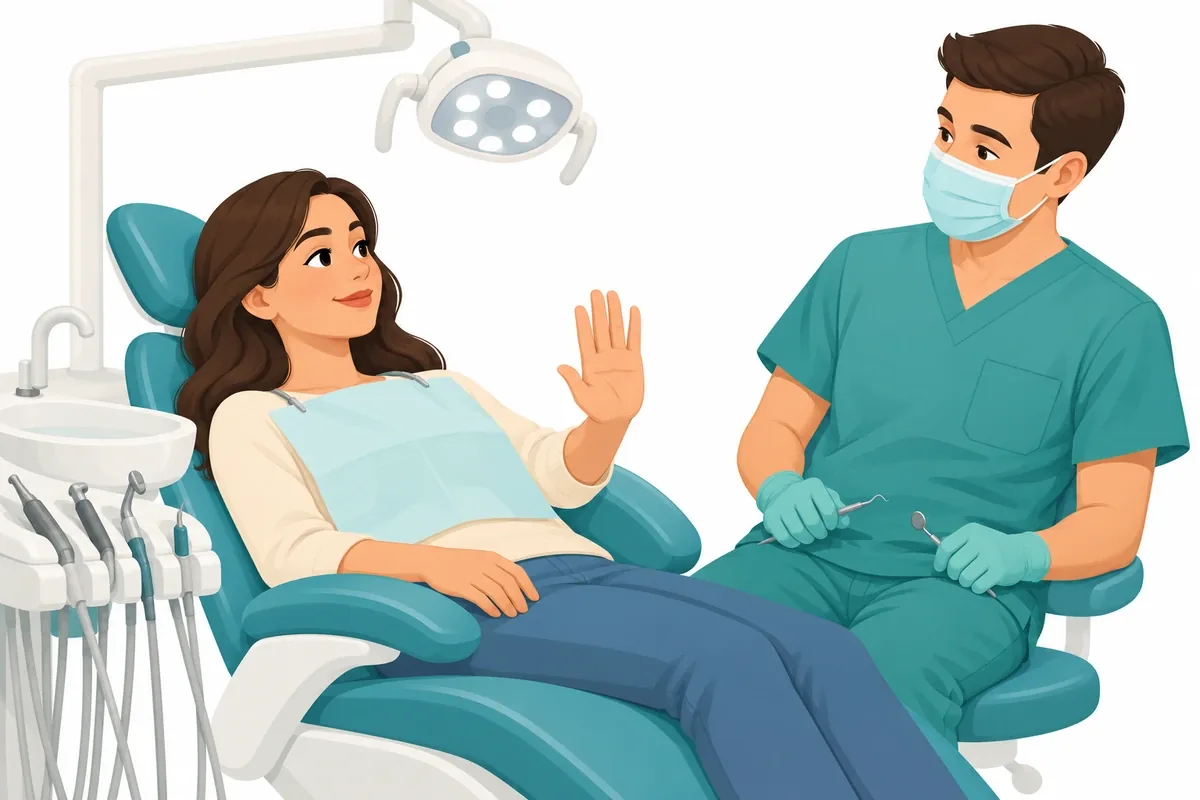
How pain is prevented
Most fear of pain in dentistry is fear of the injection and fear that the numbing will not work. Both are addressed by technique.
A numbing gel is placed on the gum first so the needle itself is barely felt. The anesthetic is then given slowly, because speed, not the needle, is what causes most of the sting. We wait for it to take effect, then test the area before starting, and if you feel anything beyond pressure and vibration, we stop and add more. Being numb means you feel pushing and movement but not pain; knowing that in advance keeps pressure from being mistaken for something going wrong.
Teeth that are infected or very inflamed can be harder to numb. If that is the case, we tell you, and we have options such as additional anesthetic placed in a different spot. You are never asked to simply tolerate it.
For routine cleanings on tender gums, a numbing gel alone is often enough. For sensitive teeth, tell the hygienist which areas react so they can be approached gently or numbed.
Managing gagging
A strong gag reflex is a physical reaction, not a failure of will, and it is common. Things that help: breathing slowly through the nose, slightly lifting your feet or pressing a thumb into the opposite palm as a distraction, sitting more upright, a small dab of numbing gel on the palate, and using smaller X-ray sensors or taking a panoramic image instead of images that sit inside the mouth. Tell us before the first X-ray, not after.
Prepare in a way that helps
- Book a time when you are least rushed and least tired, often first thing in the morning, so you are not waiting all day with it on your mind.
- Eat normally beforehand unless told otherwise. Low blood sugar makes shaky nerves worse.
- Limit caffeine that day.
- Bring your medication list, including anything taken for anxiety, sleep or blood pressure. If you already take a prescribed anti-anxiety medication, talk to your physician about whether to take it before a visit; do not take an extra dose, borrow someone else's, or combine it with alcohol. If you do take anything, you may need someone to drive you.
- Write down your questions so you do not have to hold them in your head.
- Bring a companion if that helps. For children, our children's dentistry page explains how parents can help.
- Practice slow breathing: in through the nose for four counts, out through the mouth for six. It is simple, it works, and you can do it in the chair.
If you are already in pain
Fear and pain together are a hard combination, and pain tends to win eventually. If a tooth is hurting, please do not wait for the fear to pass. Tell the office you are anxious when you call so the visit can be planned with that in mind, and read our toothache guide for what to do before you can be seen. During office hours call (817) 641-6261. If you have facial swelling that is spreading, fever, or any difficulty breathing or swallowing, go to an emergency room or call 911 first.

Sources and further reading
General information, not a diagnosis. Read how we create and review our dental guides.