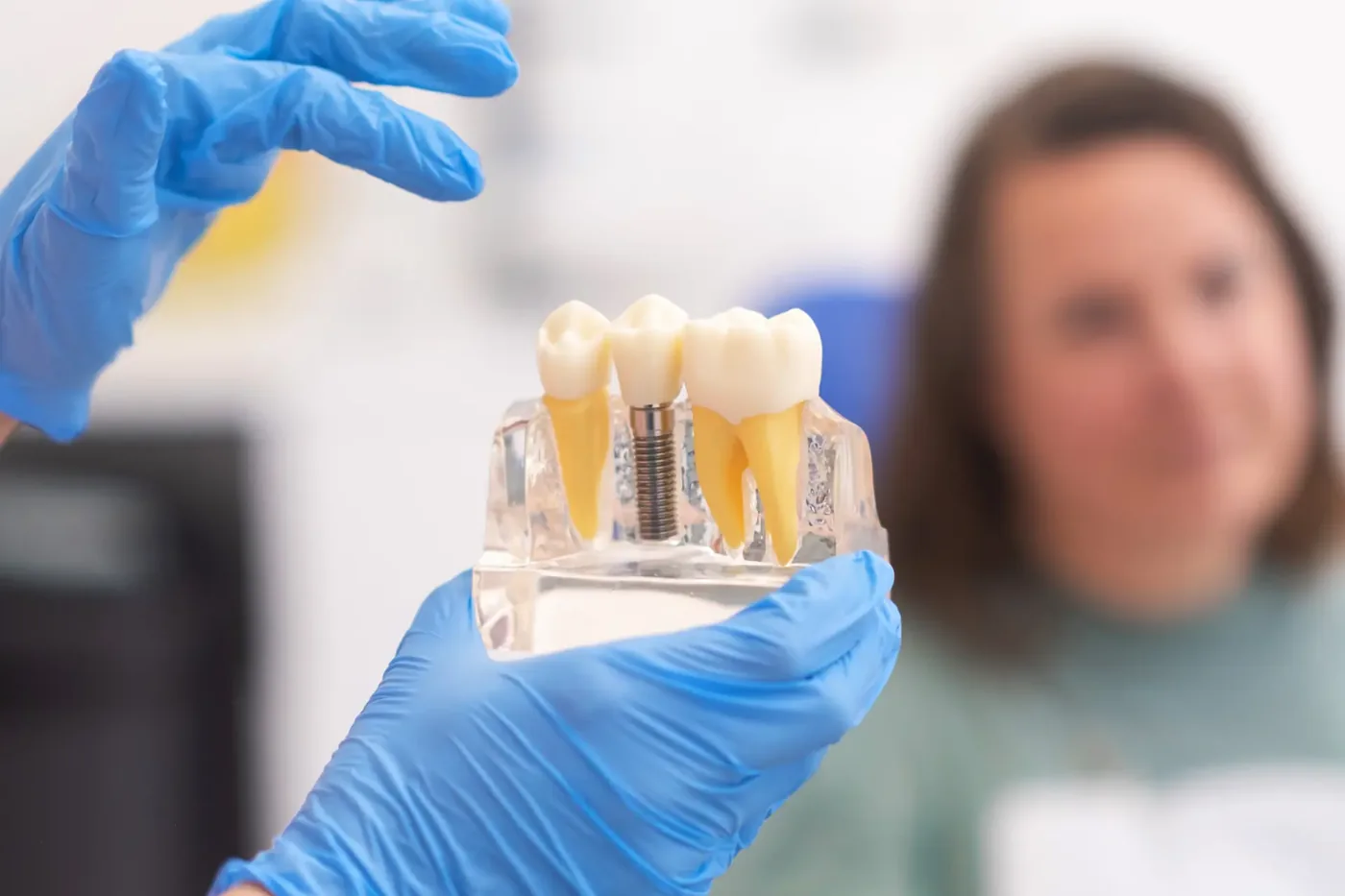
A dental implant and a conventional bridge both give you a fixed replacement for a missing tooth, meaning you do not take it out. The difference is what holds it up. An implant is a post placed in the jawbone that carries its own crown. A bridge is a row of connected crowns: the teeth on either side of the gap are reshaped and crowned, and a false tooth hangs between them.
Neither is automatically right. The healthier the neighboring teeth, the more an implant tends to make sense. The more those teeth already need work, the more a bridge can do double duty. Add bone, health, time, cleaning habits and budget to the picture and the answer becomes specific to you.
This guide, part of our dental implant services, lays out the trade-offs so you can weigh them before your visit to our Cleburne office.
How each option works
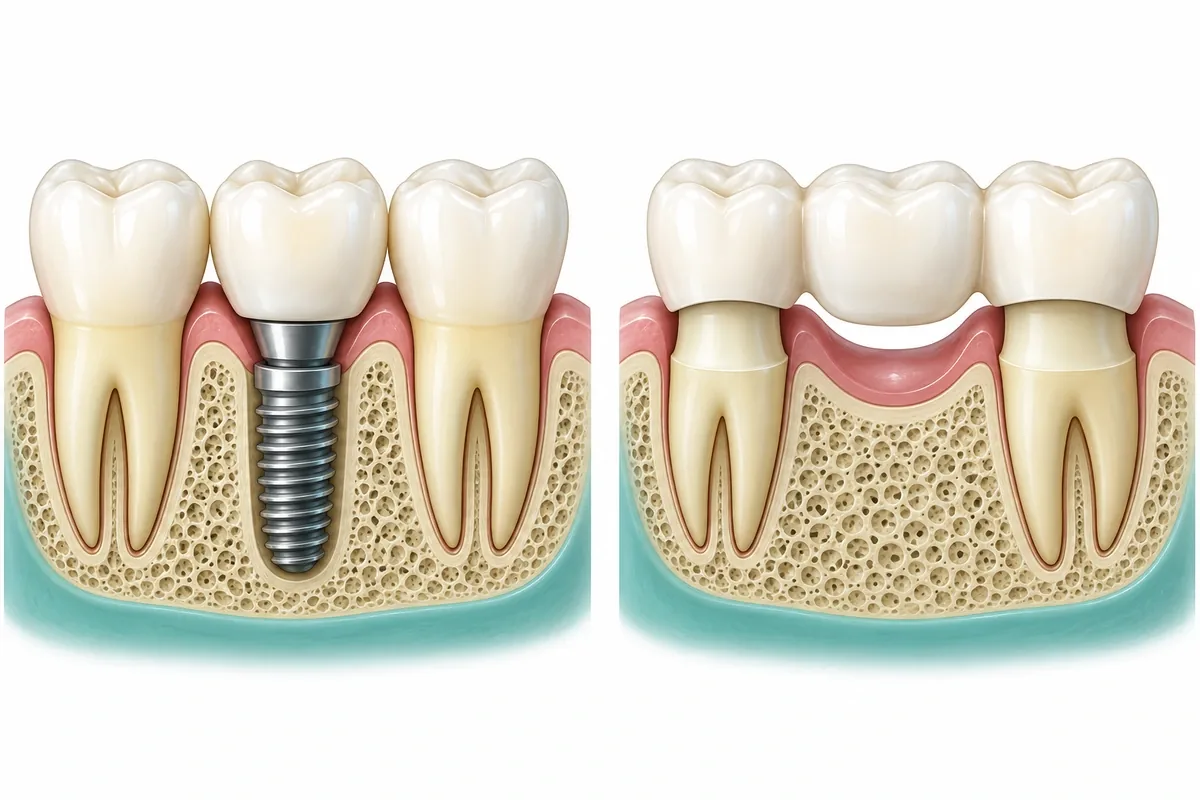
Implant. A titanium post is placed where the root was. After several months of healing, a connector and a crown are added. The replacement stands alone; the neighbors are untouched. See the single-tooth implant guide for the full process.
Conventional bridge. The two teeth beside the gap are reduced in size all the way around, impressions are taken, and a laboratory makes a single piece with three (or more) connected crowns. It is cemented over the prepared teeth, usually within a few weeks. Our dental bridges guide covers the details.
There is also a resin-bonded (Maryland) bridge, which glues a false tooth to the backs of the neighbors with small wings and minimal drilling. It is mostly for front teeth with light bite forces and is often used as a long-term temporary.
The neighboring teeth usually decide it
Ask one question first: what shape are the teeth on either side of the gap in?
- Healthy, unfilled or lightly filled. Cutting them down for a bridge removes a lot of sound enamel and commits them to crowns for life. Here, an implant is usually the more conservative choice, even though it involves surgery.
- Already crowned, heavily filled or cracked. Those teeth may benefit from crowns anyway. A bridge then solves two problems at once and avoids surgery.
- Loose, with gum disease, or with short roots. They may not be strong enough to carry a bridge, and the implant site next to them may also need gum treatment first.
- Tipped into the gap. Drifted teeth can be hard to prepare for a bridge and can leave too little room for an implant crown. Orthodontics is sometimes the first step either way.
Surgery, healing and total time
An implant requires at least one surgical visit and several months of healing, sometimes more if a bone graft is needed. A bridge involves no surgery and is typically finished in two or three visits over a few weeks.
That speed is real, but it should not be the only factor. A tooth being prepared for a bridge is drilled and can become sensitive or, occasionally, need a root canal later. And an implant's longer timeline does not mean a visible gap the whole time; a temporary tooth is usually possible. The implant timeline guide explains what to expect.
Appearance
Both can look excellent. For a front tooth, an implant lets the gum shape itself around a single crown, which can look very natural if the bone and gum are adequate. A bridge can be the better-looking choice when bone has already shrunk, because the false tooth can be shaped to cover the defect with pink porcelain or a longer tooth. Where the gumline is high and visible, the design matters more than the category.
Cleaning and daily life
An implant crown is flossed like a natural tooth. A bridge is one connected piece, so you cannot floss between the units; you pass floss under the false tooth with a threader or use a water flosser. Both are manageable, but bridges demand that extra step every day. Food packing under a bridge that is not cleaned leads to decay on the supporting teeth, which is the most common reason bridges fail.
What tends to go wrong, and what repair involves
| Implant | Bridge | |
|---|---|---|
| Can decay | The implant cannot; neighbors are unaffected | The supporting teeth can, under the crown margins |
| Gum problems | Inflammation around the implant if plaque builds | Gum disease around supporting teeth |
| Mechanical | Loose screw, chipped porcelain | Chipped porcelain, loss of cement |
| If one part fails | Crown can usually be remade; implant stays | Often the whole bridge must be replaced, sometimes with an extra tooth lost |
| Protects jawbone at the site | Yes, through chewing load | No; the ridge under the false tooth slowly shrinks |
The last row is often overlooked. Bone under a bridge keeps resorbing, so if the bridge fails years later, the site may need grafting before an implant becomes possible.
Cost over time
A bridge is usually less expensive up front. An implant is usually more expensive up front but tends to need less re-doing over the years, and it does not put the neighbors at risk. When you compare, ask for complete estimates: the implant estimate should list the implant, abutment, crown, imaging and any grafting; the bridge estimate should list the span, the preparation of each supporting tooth, and the temporary. Then ask what each is likely to need in ten years. The financing page explains payment options for either.
When leaving the space alone is reasonable
Not every gap has to be filled right away. A missing second molar at the back, with nothing opposing it, may be left and watched. But most spaces do change over time: neighbors tip, the opposing tooth drifts down, food traps develop and bone shrinks. If you choose to wait, ask what to watch for and when the window for a simple implant might close. Our guide on replacement after an extraction covers that decision.
Getting a recommendation based on your mouth
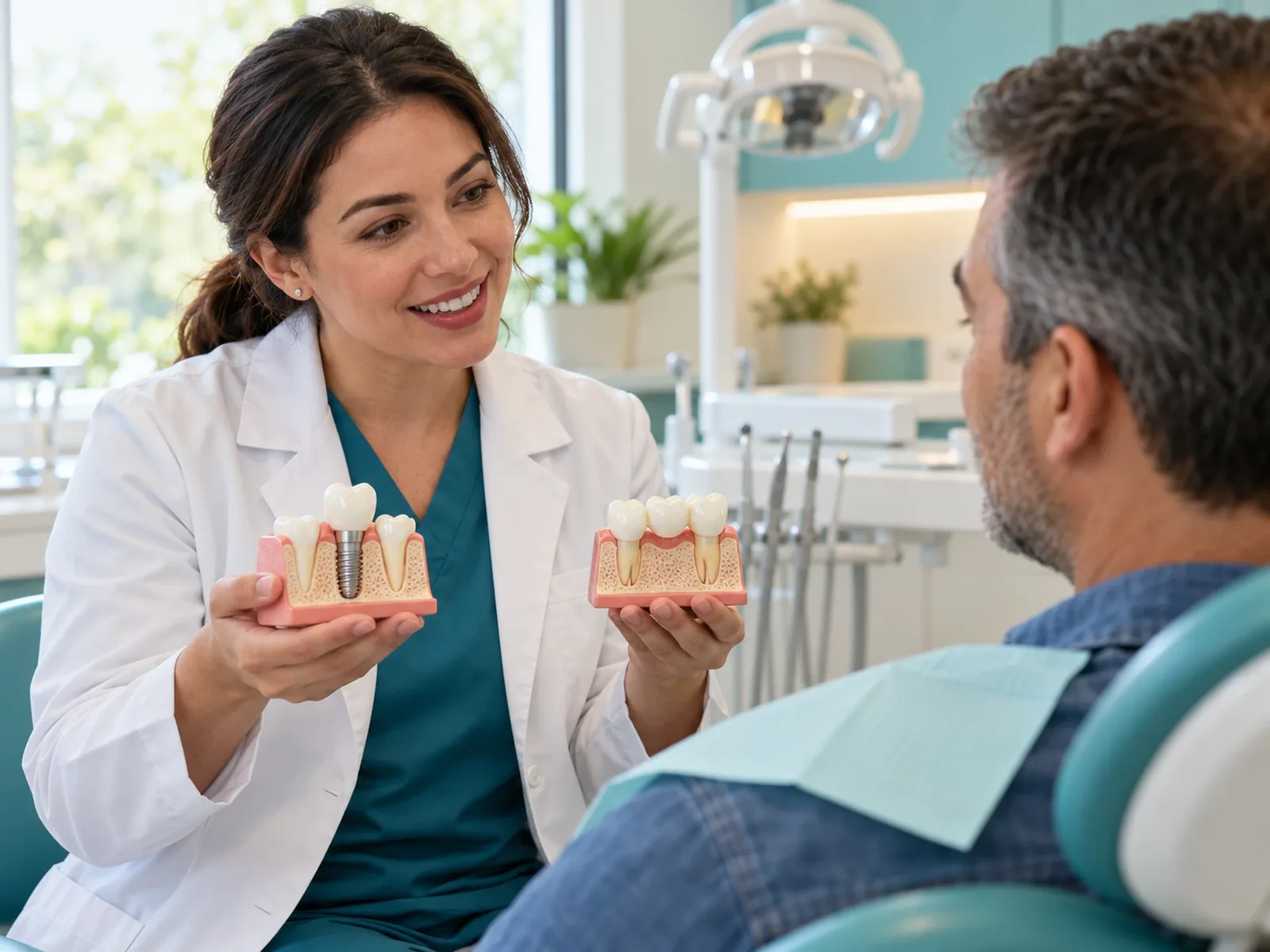
The implant-or-bridge question has a clear answer once we can see the neighboring teeth and the bone. Dr. Zohdi will show you both plans side by side, with the costs and the likely maintenance for each, and let you decide. Request an appointment at our Cleburne office, 302 N Ridgeway Dr, or call (817) 641-6261.
Sources and further reading
General information, not a diagnosis. Read how we create and review our dental guides.