
Removing a tooth and deciding what belongs in its place are one decision, not two. The way an extraction is done, whether a graft goes in the socket, and whether you walk out with a temporary tooth all depend on what the long-term plan is. That is why we ask "what should go here?" before the tooth comes out, even when the answer is "nothing."
Not every missing tooth needs replacing. A wisdom tooth, or a back molar with no tooth above or below it to bite against, can often be left alone. But most teeth have jobs beyond chewing: holding their neighbors upright, keeping the opposing tooth in place, and preserving the bone around them. When one is lost, those jobs go unfilled, and the mouth slowly rearranges itself around the gap.
This page explains what changes after an extraction, compares the main replacement options, walks through the timing of each, and covers the temporary teeth and site-preservation steps that connect the extraction to the final result. At Cleburne Dental, Dr. Zohdi lays this sequence out before any extraction or other oral surgery so there are no surprises.
What changes in the space after a tooth is removed
The bone that surrounded the root exists to hold a tooth. Once the tooth is gone, the body begins to resorb it. The ridge loses the most width and height in the first several months, with slower change continuing for years. Over time:
- Neighboring teeth tip toward the gap, opening spaces that trap food and changing how the bite meets.
- The opposing tooth drifts down or up into the space because nothing stops it, which can expose its root and complicate later replacement.
- Chewing shifts to the other side, overloading those teeth.
- The gum and bone contour flattens, which matters for appearance in the front and for implant placement anywhere.
None of this happens overnight, and the amount varies, but it is why options narrow the longer a space is left and why planning early keeps more doors open.
The main options
| Dental implant | Fixed bridge | Removable partial denture | Leave the space | |
|---|---|---|---|---|
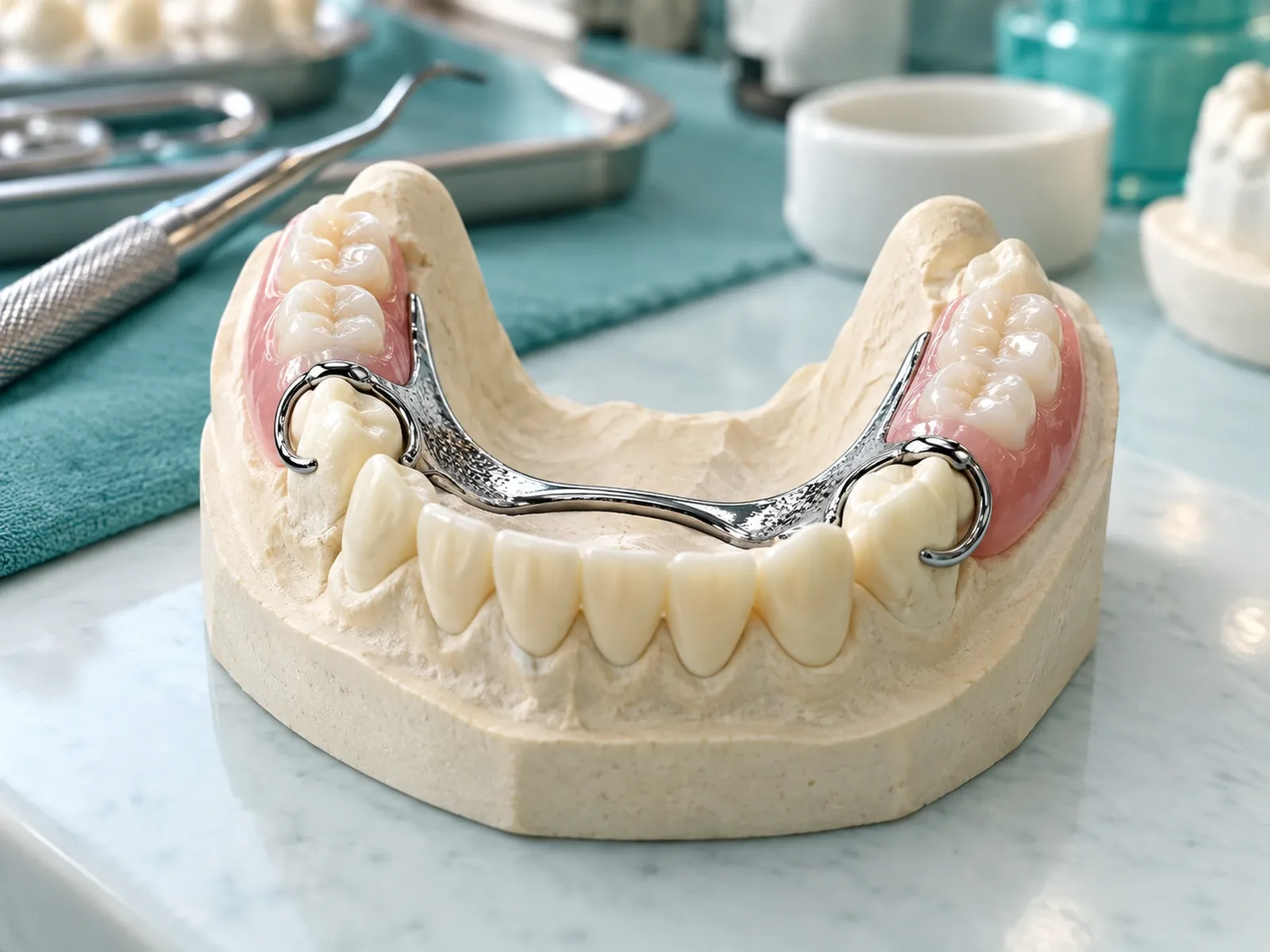
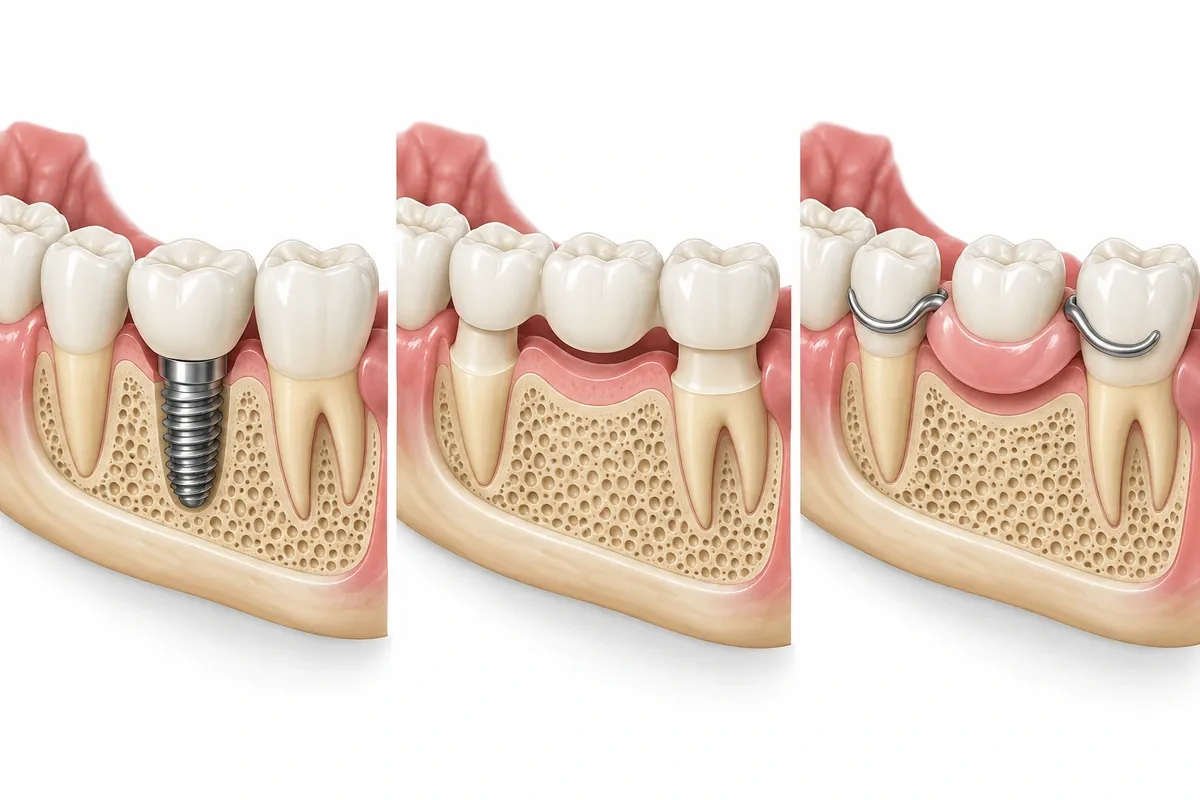
| How it works | A titanium post in the bone supports a crown | A false tooth is attached to crowns on the two neighboring teeth | A removable plate carries one or more teeth, held by clasps | No replacement |
| Effect on other teeth | None; stands alone | Neighboring teeth are trimmed for crowns | Clasps rest on neighboring teeth | Neighbors may drift |
| Bone | Stimulates and helps preserve bone | Bone under the false tooth still shrinks | Bone still shrinks | Bone shrinks |
| Time to final result | Usually several months | A few weeks after healing | A few weeks after healing | None |
| Daily care | Brush and floss like a tooth | Floss threader or water flosser under the false tooth | Remove and clean daily | Monitor |
| Typical lifespan | Long; crown may need replacement | Long; depends on supporting teeth | Shorter; relines and remakes over time | Not applicable |
A single-tooth implant is often the first choice when bone and health allow because it leaves neighboring teeth untouched. A fixed bridge is a good answer when the neighboring teeth already need crowns or when an implant is not possible. A removable partial denture replaces one or many teeth at lower cost and without surgery, at the expense of being removable. Our comparison of an implant versus a bridge weighs the two fixed options in more detail.
Timing: when each option is placed
Replacement timing is set by healing, not by the calendar.
- Immediate implant. In selected cases the implant is placed in the socket the same day the tooth comes out. This requires a socket free of active infection and enough bone beyond the root tip to hold the implant steady. Even then, the final crown usually waits several months for the implant to fuse with bone.
- Early implant. Placed a couple of months after extraction, once the gum has closed but before much bone is lost. This is a common approach for front teeth.
- Delayed implant. Placed after the socket has filled with bone, often three to six months, or later if a graft is healing. Our implant treatment timeline page walks through each stage.
- Bridge or partial denture. Usually made after the gum has healed and settled, a few weeks to a couple of months after extraction, so the final fit does not change as the ridge shrinks.
Which approach fits you depends on the X-ray, the condition of the socket, your health, and whether you need something visible in the meantime. Our page on implant candidacy explains what we evaluate.
Why the site may need attention at the time of extraction
If an implant is the plan, the extraction itself changes. Dr. Zohdi removes the tooth as gently as possible to keep the thin outer wall of bone intact, and often places a socket preservation graft: bone material packed into the socket and covered with a membrane so the ridge holds its shape while it heals. This can mean a simpler implant placement later and a better-looking result in the front.
Socket preservation is not required for every extraction. Teeth that will be left unreplaced, sockets with thick surrounding bone, and some back teeth do fine without it. It also does not guarantee that no graft will ever be needed; if the ridge has already shrunk, ridge augmentation may still be part of the plan. We will tell you whether grafting changes your options or simply adds cost.
Temporary teeth are a separate decision
A visible gap, especially in the front, is a real concern, and there are several ways to cover it during healing:
- A flipper: a small removable acrylic plate with one tooth, light and inexpensive, meant for appearance rather than chewing.
- A clear retainer with a tooth built in, nearly invisible, also for appearance.
- A bonded temporary: a false tooth glued to the back of the neighboring teeth, fixed in place but fragile.
- An immediate denture when several teeth are removed; see our immediate denture page.
- A temporary crown on an immediate implant in selected front-tooth cases, kept out of the bite.
Ask whether a temporary is included in the plan and estimate, how it is cleaned, and whether you can chew on it. Temporaries need adjustment as the gum shrinks, and they are not built to last indefinitely. The dentist should tell you how long yours is meant to serve and when it will be reviewed.
Building a practical sequence
A good plan names each step and roughly when it happens. A typical implant sequence after a non-urgent extraction: extraction with a socket graft and a temporary if needed; a check at about one week; three to four months of healing; implant placement; several more months of healing; then the abutment and final crown. A bridge sequence is shorter: extraction, several weeks of healing, preparation of the neighbors with a temporary bridge, then the final bridge.
If finances or scheduling require stages, say so. Some delays are harmless; others, such as leaving a front-tooth socket ungrafted for a year, can change what is possible. Our payment and financing page explains ways to spread the cost across stages.
What affects the cost
Replacement cost depends on the option chosen, whether grafting is needed, the imaging involved, whether a temporary tooth is made, and the materials of the final restoration. An implant path has more steps and a higher total than a partial denture; a bridge falls between but may cost more over time if a supporting tooth later fails. Ask for the full-path estimate rather than the first-step fee, and check insurance coverage for each step, since plans often cover extractions and dentures differently from implants.
Risks and alternatives
Each option has drawbacks. Implants involve minor surgery, months of healing, and a small risk of failing to fuse with bone, higher in smokers and uncontrolled diabetes. Bridges require trimming neighboring teeth and depend on them staying healthy. Partial dentures can loosen, trap food, and wear on the teeth they clasp. Leaving a space risks drifting and bone loss but is an acceptable choice for some teeth.
The alternative to all of this is keeping the natural tooth when that is realistic; if you have not yet decided, our guide on whether a tooth can be saved comes first.
Sources and further reading
- ADA MouthHealthy: Extractions
- FDA: Dental implants—what you should know
- ADA MouthHealthy: Bridges
- ADA MouthHealthy: Implants
General information, not a diagnosis. Read how we create and review our dental guides.