Full-Mouth Reconstruction in Cleburne: Planning Health and Function
When many teeth are damaged, worn, or missing, fixing them one at a time stops working. Full-mouth reconstruction is a coordinated plan that restores health first, then function, then appearance.
Some mouths reach a point where patching one tooth at a time no longer makes sense. Several teeth are broken down or missing, old crowns and fillings are failing, the gums are inflamed, the bite has shifted, and the teeth that remain are worn short. Each problem affects the others, so each repair made in isolation is undermined by the problems around it.
Full-mouth reconstruction is the answer to that situation. It is not a specific set of procedures; it is a coordinated plan that treats the whole mouth as one system. It may combine gum treatment, fillings, root canals, extractions, bone grafting, implants, crowns, bridges, and a rebuilt bite, in whatever mix your diagnosis requires. Some reconstructions keep every salvageable tooth. Others replace an entire arch. Most fall in between.
This page introduces how Dr. Zohdi approaches complex cases in Cleburne and links to the detailed guides on sequencing, worn teeth, cost, and second opinions. The term should describe a real clinical need, and the plan should be built around your mouth, your goals, and your capacity to maintain the result.
Reconstruction is considered when problems are both widespread and interconnected. Typical situations include:
Many teeth with decay, fractures, or failing restorations at once
Teeth worn short from years of grinding or acid, so the bite has collapsed
Multiple missing teeth with the remaining teeth drifting and over-erupting
Advanced gum disease that has loosened teeth and destroyed bone
Old dental work done piecemeal over decades that no longer fits together
Damage from trauma, long-term medication effects, or developmental conditions
If your concern is a single tooth, or a few, you most likely need restorative dentistry rather than a reconstruction plan; our services directory lists every option. If your main concern is appearance in an otherwise healthy mouth, start with cosmetic dentistry.
Define the problems before choosing procedures
A reconstruction begins with a thorough diagnosis, not a list of procedures. Dr. Zohdi gathers photographs, X-rays and often a three-dimensional scan, gum measurements for every tooth, impressions or digital scans, and a record of how your teeth meet and your jaw moves. From this, every tooth gets an honest prognosis: sound, treatable, questionable, or not worth saving.
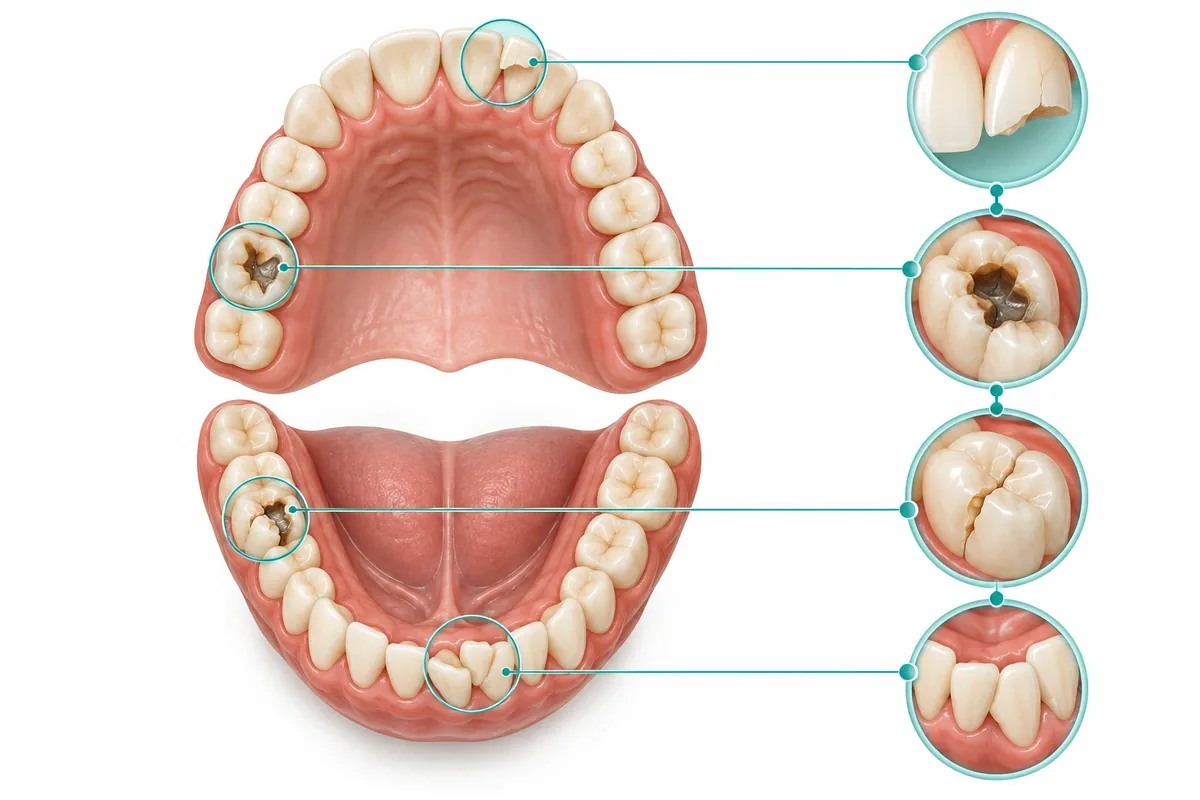
Illustration: separate problems in one mouth become one coordinated, staged plan. Educational diagram, not a patient photo.
That sorting determines which pathway fits. Preserving natural teeth and replacing an entire arch are different plans with different commitments. Full-arch implant teeth are one possible route, not a synonym for reconstruction, and they make sense when most teeth in an arch are truly beyond saving. When sound roots remain, keeping them is often the better long-term decision. Ask which teeth can be maintained and exactly why any extraction is recommended.
Worn teeth deserve special attention because the cause matters as much as the repair. Our guide to restoring worn teeth explains how grinding and acid erosion are told apart and why new dental work must be protected from the same forces.
Build the sequence around health and function
Complex treatment runs in stages, and the order is deliberate. Pain and infection are treated first. Decay and gum disease are brought under control. Hopeless teeth are removed and, where implants are planned, the sockets may be grafted. Then come healing periods for grafts and implants, which cannot be hurried.
Before anything is made in final materials, the proposed result is tested. A wax-up or digital design shows the planned teeth; a trial smile transfers it onto your teeth temporarily; provisional restorations are worn for weeks or months so you can chew, speak, and clean with them. Problems are fixed in plastic, not discovered in porcelain. When the bite is being changed, this trial phase is especially important.
Because "full-mouth reconstruction" covers such different plans, a single price is meaningless. What you need is an itemized, staged estimate: records, disease control, surgery, temporaries, final restorations named tooth by tooth, protection, and follow-up, each with its fee and with the uncertainties spelled out. Our reconstruction cost guide explains how to read one, how to compare a plan that keeps teeth with one that replaces an arch, and how phasing over time can work without compromising the clinical order.
When several teeth are proposed for treatment or extraction, or the alternatives are unclear, a second opinion is reasonable and welcome. Bring your images, gum measurements, and the written plan so the conversation can focus on findings and prognosis rather than labels. Our dental second opinions page explains how to prepare and how to compare two plans fairly.
What a reconstruction visit is like
Individual appointments feel much like their ordinary counterparts: local anesthesia, clear explanation of what is happening, a pause signal if you need a break, and a pace set by you. Long appointments are broken up with rests. Between visits you will always have functional, presentable temporary teeth; being left with gaps is not part of a good plan.
Dr. Zohdi coordinates the stages so the bite is never lost, usually working one arch or one section at a time. Where a case calls for an outside provider, that referral is arranged as part of the plan rather than as an afterthought.
Set realistic expectations
No reconstruction is maintenance-free. Natural teeth that were restored can still decay at the edges and still need healthy gums. Implants can develop inflammation if plaque collects around them, and their components can wear or loosen. Ceramics can chip. A night guard is often part of the plan to protect the result, and a closer recall schedule in the first year is normal.
Jaw pain is a separate matter. Worn teeth and jaw symptoms often travel together because clenching causes both, but rebuilding the teeth is not a routine cure for jaw problems. Jaw joint and muscle symptoms need their own evaluation, and extensive bite changes should never be sold as a shortcut for them.
Is full-mouth reconstruction the same as a smile makeover?
No. A smile makeover is primarily about appearance in a mouth that is already healthy. Reconstruction is driven by disease, damage, and function; a better appearance is a welcome result, not the starting point.
Do I have to do everything at once?
Rarely. Most plans are staged over months, and many can be phased for budget as long as urgent and protective steps come first. Ask which stages can safely be separated.
Will I lose all my teeth?
Only if they truly cannot be saved. A good plan judges each tooth on its own prognosis. Removing sound teeth to simplify a plan is a decision that deserves a clear explanation.
How long does it take?
From a few months for a plan without surgery to a year or more when grafting and implants are involved, because biological healing sets the pace.
Is it painful?
Individual procedures are done with local anesthesia and should not be painful. Recovery after extractions or implant surgery involves several days of soreness and swelling managed with ordinary pain relievers or a short prescription.
Can I get a second opinion on a plan from another office?
Yes, and we encourage it for plans this large. Bring your records and the written plan, and we will explain what we see and how the options compare.
If your dental problems have piled up to the point where you are not sure where to start, the first step is a thorough look and an honest conversation. Request a comprehensive consultation at our Cleburne office. Tell us what matters most to you: comfort, chewing, appearance, time, or budget. We will build a staged plan that explains the purpose of every step.