
Hillsboro is the Hill County seat, a city of about 8,200 at the 2020 census sitting on I-35 where SH-22 and SH-171 cross it, home to a landmark courthouse and the main campus of Hill College, which began as Hillsboro Junior College in 1923. It is a commuter town as much as a county town: people here drive north toward Fort Worth and south toward Waco for work, and students and staff organize their lives by the semester. Dental care for someone in that position needs to be organized the same way, as a course of treatment with a known shape rather than a string of surprise appointments.
Cleburne Dental is located at 302 N Ridgeway Dr, Cleburne, TX 76033. That is our only office. We have no Hillsboro location, no local number and no staff in Hill County. If you come to us, use the full address in your maps app from your own starting point.
This page is about planning a course of care. If you have been told you need several crowns, gum treatment and an implant or two, or you have a mouth full of old work that is failing at once, here is how that gets organized and where your schedule fits in.
Why complex care has an order
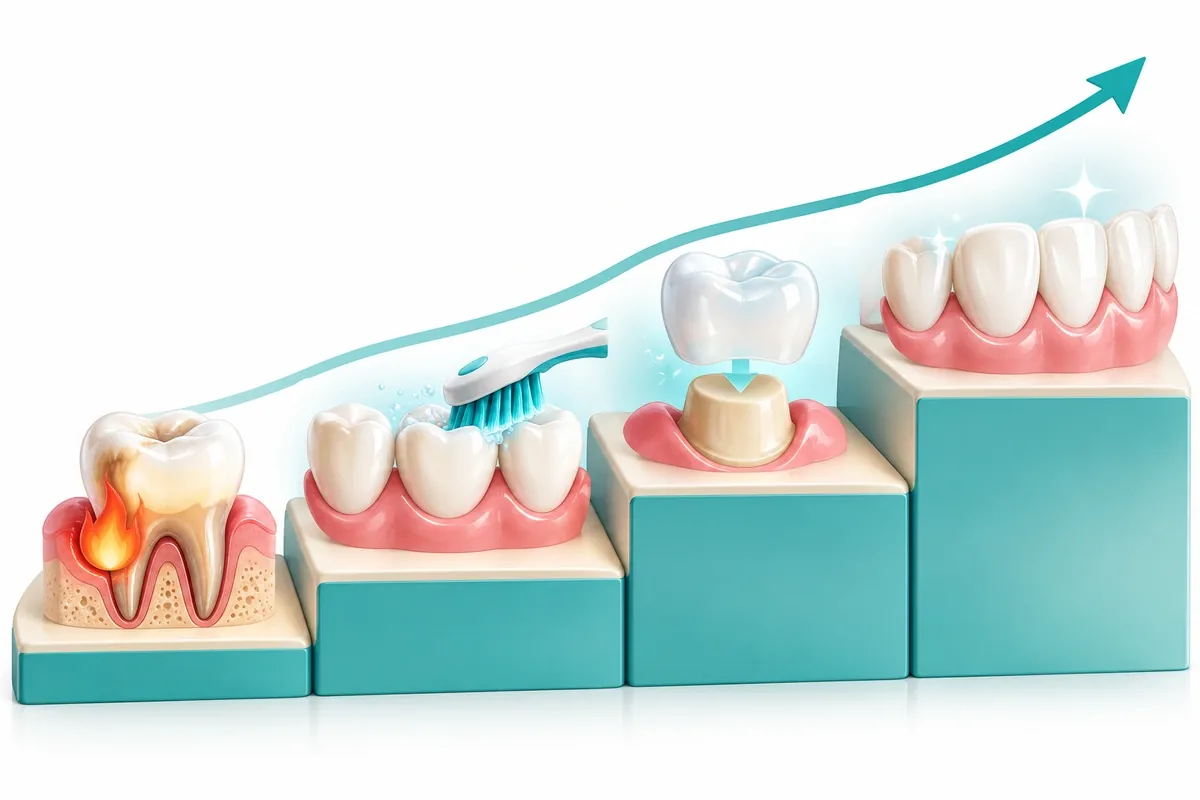
When several things are wrong, dentists do not simply work left to right. Most comprehensive plans move through four phases, and the order exists for clinical reasons:
- Urgent and infection control. Teeth that hurt, abscesses and hopeless teeth are dealt with first. Pain and infection do not wait for the rest of the plan.
- Foundation. Gum disease is treated, usually with scaling and root planing, and decay is removed. Crowns and implants built on inflamed gums do not last.
- Provisional work. Teeth are protected with temporary crowns or an interim partial while healing happens and the bite is tested.
- Final restorations. Permanent crowns, bridges, implants or dentures are made once everything underneath is stable.
Our treatment planning guide explains each phase, and the full-mouth reconstruction hub describes when a plan reaches that scale.
Where your schedule has leverage, and where it does not
A good plan is firm about sequence and flexible about dates. For someone commuting on I-35 or living by a Hill College calendar, that distinction matters.
You can usually move:
- The day of the week for routine phases such as gum treatment or impressions.
- Grouping two shorter procedures into one longer visit, within reason.
- Scheduling the surgical stage over a break or a long weekend so the recovery days are not workdays. Read recovering from implant surgery before choosing the date.
- Placing a hygiene visit on the same day as another appointment.
You usually cannot move:
- Healing time after extractions, grafting or implant placement before the next stage.
- Lab turnaround between impressions and delivery.
- Re-evaluation of gums before final work goes in. Our guide on why periodontal maintenance differs from a regular cleaning explains why this check is not optional.
- Treating infection before anything cosmetic.
Our hours are Monday through Thursday, 8:00 AM to 5:00 PM. Tell us your constraints at the consultation, whether that is a fixed work shift or a class schedule, and we will build the sequence around days you already have free rather than asking you to take leave repeatedly.
What to bring so the first visit produces a plan
Ask your current or previous dentist to send recent X-rays, any 3D scan, periodontal charting and the written plan or estimate if one exists. You have a right to copies, and recent images usually need not be repeated. Bring your medication list and any medical conditions that affect healing. If you want a second opinion on an existing plan, bring the itemized estimate so we can compare stage by stage. Our new patient page lists the forms you can complete before you arrive.
Ask at the end of the consultation for the sequence in writing with an estimated number of visits per phase. Two plans that cover different scopes cannot be compared on price; the cost comparison guide explains what to check.

Implants, dentures and keeping teeth within a bigger plan
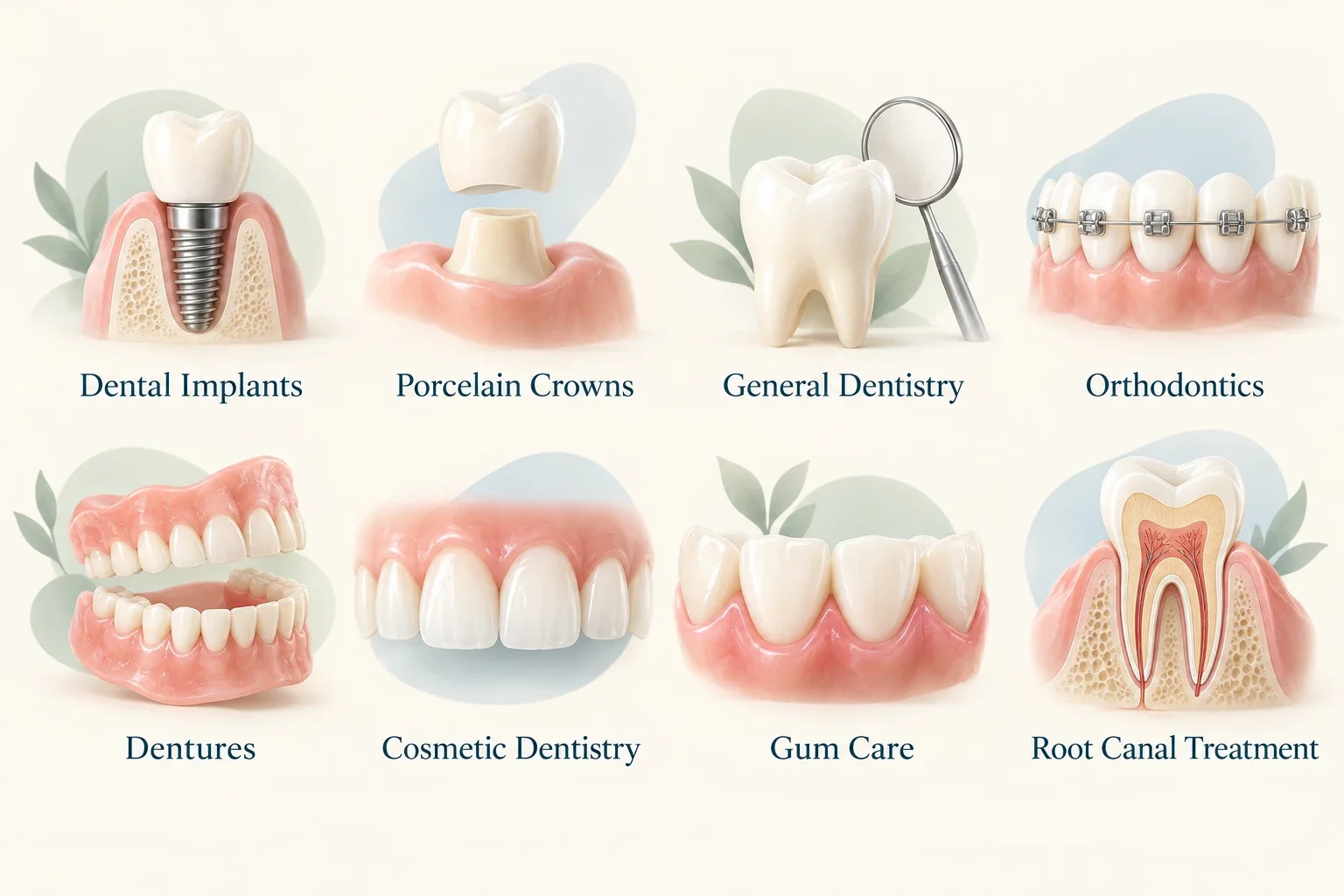
A long plan still comes down to individual choices. Where a tooth can be kept, a crown or root canal is often fewer visits than removal and replacement. Where teeth are gone, implants can support a single crown, a bridge or a removable implant denture, each with different cleaning and repair demands. An existing denture may only need a reline to carry you through the rest of the plan. Ask about each decision on its own rather than accepting a bundle.
Between visits: who to call and when to go to the ER
- During office hours (Mon–Thu, 8–5): call (817) 641-6261 for pain, a loose temporary, or anything that worries you. Most issues can be assessed by phone first.
- A temporary crown comes off: keep it, avoid chewing on that side, and call. See a crown or filling came out.
- After hours: read what to do when a dental problem happens after hours.
- Go to the nearest emergency room or call 911 for trouble breathing or swallowing, swelling spreading toward the eye or down the neck, bleeding that will not stop with firm pressure, or major facial trauma. Do not drive to Cleburne for those.
Sources and further reading
- Texas State Historical Association, Handbook of Texas: Hillsboro, TX
- City of Hillsboro: About the City of Hillsboro
- Wikipedia: Hillsboro, Texas (Hill County seat, I-35, SH-22, SH-171, 2020 census population, Hill College)
- Hill College
- American Academy of Periodontology: Gum disease information
General information, not a diagnosis. Read how we create and review our dental guides.